

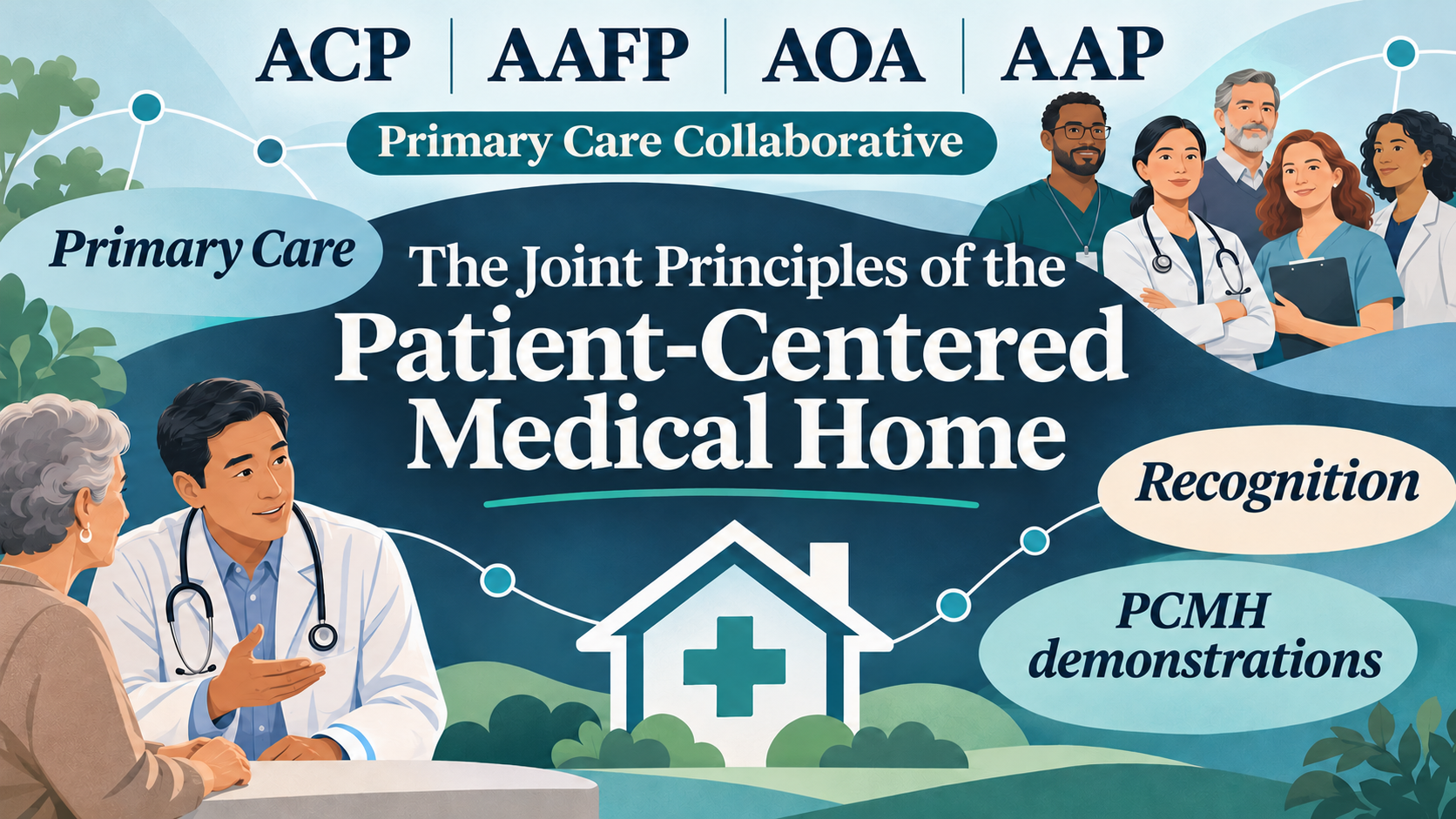
Earlier this month, I had the privilege of attending the Primary Care Collaborative’s (PCC) 20th anniversary. Many of us who were there at the beginning attended to celebrate the organization and its ongoing efforts to promote and sustain primary care. The event made me reflect on the history. The story reminds us that translating policy into practice, and informing policy through practice, are goals worthy of persistent, sustained effort.
The PCC launched as the Patient-Centered Primary Care Collaborative (PCPCC) in 2006. Four medical professional societies (ACP, AAP, AAFP, AOA), IBM, and other major employers convened the initial meetings to promote and support primary care, in general, and the patient-centered medical home specifically. Driven by IBM, the organizations drew from their respective policy papers, including ACP’s Advanced Medical Home, AAFP’s Future of Family Medicine, and the AAP’s original push for the pediatric medical home in 1967, to draft The Joint Principles of the Patient-Centered Medical Home.

By December 2006, Congress called for demonstrations of the “Medicare Medical Home” in Section 204 of the Tax Relief and Health Care Act. In March 2007, The Joint Principles of the Patient-Centered Medical Home (PCMH) were released by ACP, AAP, AAFP, and AOA. Then, in January 2008, the National Committee for Quality Assurance (NCQA), in collaboration with medical professional societies, the Commonwealth Fund, and others, launched the first recognition program, Physician Practice Connections, Patient-Centered Medical Home (PCC-PCMH). URAC, AAAHC, and The Joint Commission later followed with their own PCMH accreditation programs. Multiple organizations subsequently endorsed The Joint Principles, including the American Medical Association.
HHS then steadily launched programs that leveraged elements of the PCMH principles and goals. The table at the end of this post provides a general overview of several national and state programs.
At its peak, health plans offered incentive payments to recognized/accredited practices, malpractice carriers offered discounts, and NCQA recognized over 10,000 sites and 50,000 clinicians. NCQA continued to iterate on the PCMH program (2008, 2011, 2014, 2017…). Over the past few years, NCQA expanded its offerings to include Primary Care Advancement and recently (July 2026) held an open comment period for its Advanced Primary Care Accreditation program.
Many challenges still need to be addressed. However, what the PCMH model and PCC efforts have shown is that concerted, sustained efforts by dedicated individuals and groups, professional societies, employers, health services researchers, foundations, policymakers, and patients can generate positive change.
Overview of Related Primary Care Programs
| Launch | Program or demonstration | Agency | Primary focus and relationship to PCMH |
|---|---|---|---|
| 2007 | Medicare Care Management Performance Demonstration (MCMP) | CMS | Supported small and medium-sized primary care practices through financial incentives for chronic disease management, quality performance, and electronic health record use. |
| 2007–2008 | Medicare Medical Home Demonstration | CMS | Designed to test payment for accessible, continuous, coordinated care for Medicare beneficiaries with chronic conditions. CMS ultimately did not implement this demonstration. |
| 2011 | Multi-Payer Advanced Primary Care Practice Demonstration (MAPCP) | CMMI | Engaged Medicare, Medicaid, and commercial payers in eight states to support PCMH transformation through enhanced payments and care coordination infrastructure. |
| 2011 | FQHC Advanced Primary Care Practice Demonstration | CMMI/HRSA | Supported federally qualified health centers in achieving PCMH recognition and improving access, team-based care, care management, and quality. (downloads.cms.gov) |
| 2011 | HRSA PCMH Recognition Initiative | HRSA | Provided financial and technical assistance to health centers pursuing PCMH recognition and strengthening their primary care delivery capabilities. (hrsa.gov) |
| 2011–2012 | Medicaid Health Homes | CMS/Medicaid | Established a state plan option to support whole-person care, chronic condition management, transitional care, behavioral health integration, and community service coordination. (Medicaid) |
| 2012 | Independence at Home Demonstration | CMMI | Tested comprehensive home-based primary care for Medicare beneficiaries with complex chronic conditions, including interdisciplinary teams and financial accountability. |
| 2012 | Health Care Innovation Awards: Primary Care Redesign | CMMI | Funded locally developed innovations involving primary care redesign, workforce transformation, team-based care, and improved management of high-risk populations. |
| 2012 | Comprehensive Primary Care Initiative (CPC) | CMMI | Tested multi-payer financing of advanced primary care, including risk stratification, access and continuity, preventive care, patient engagement, and care coordination. |
| 2013 | State Innovation Models Initiative (SIM) | CMMI | Supported state-led payment and delivery system transformation. Several states incorporated PCMHs, community health teams, and advanced primary care payment models. |
| 2015 | Transforming Clinical Practice Initiative (TCPI) | CMMI | Provided practice transformation assistance to more than 140,000 primary and specialty care clinicians through learning networks, quality improvement, and preparation for alternative payment models. Announced in 2014. |
| 2015 | EvidenceNOW | AHRQ | Helped smaller primary care practices build quality improvement capabilities through practice facilitation, expert consultation, and implementation of clinical evidence. (Agency for Healthcare Research and Quality) |
| 2017 | Comprehensive Primary Care Plus (CPC+) | CMMI | Expanded the CPC model through two participation tracks, enhanced primary care payments, performance incentives, health IT support, and comprehensive care delivery requirements. |
| 2019 | Maryland Primary Care Program (MDPCP) | CMMI/Maryland | Supported advanced primary care through enhanced payments, interdisciplinary care management, Care Transformation Organizations, and performance incentives. |
| 2020 | Integrated Care for Kids (InCK) | CMMI | Promoted family-centered coordination of physical, behavioral, and social services for children covered by Medicaid and CHIP through integrated delivery and payment approaches. |
| 2021 | Primary Care First (PCF) | CMMI | Built on CPC+ with greater payment flexibility, performance-based incentives, enhanced access, and accountability for outcomes among patients with complex needs. |
| 2024 | Making Care Primary (MCP) | CMMI | Introduced three progressive participation tracks to build advanced primary care capabilities, strengthen specialty partnerships, address social needs, and transition toward prospective payment. Ended early in June 2025. |
| 2025 | ACO Primary Care Flex (ACO PC Flex) | CMMI | Tests prospective primary care payments and increased investment in primary care within eligible Medicare Shared Savings Program ACOs. |
| 2026 | AHEAD: Primary Care Component | CMMI | Incorporates enhanced primary care payments, multi-payer alignment, quality incentives, and population health improvement within a statewide total-cost-of-care model. |
Leave a Reply